
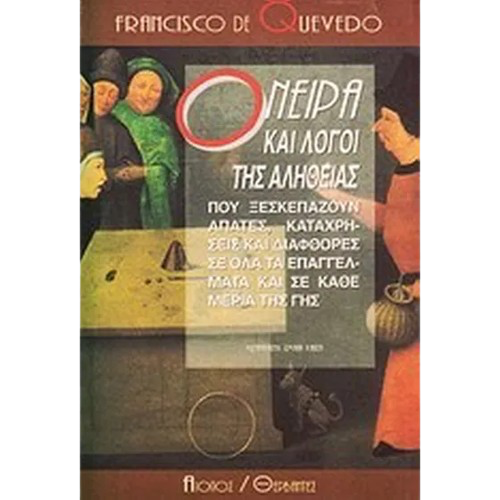
FRANCISCO
GOMEZ DE QUEVEDO Y SANTIBANEZ VILLEGAS
Francisco de Quevedo was born in Madrid in 1580 into an aristocratic family, a circumstance that supported his political ambitions.
He studied philosophy, languages, and theology. At the age of eighteen he published his first poems, and by twenty-three he was already a well-known literary figure.
The political and economic decline of Spain—gradually losing its former glory and its dominance in European affairs—formed the backdrop for Francisco de Quevedo’s satire, skepticism, and bitterness.
At the same time, Spain experienced its so-called Golden Age, a period of remarkable artistic and literary flourishing that contrasted sharply with its social decay.
Most accounts of Quevedo’s life amount to a summary of events, as his complex and enigmatic existence is surrounded by shadows and rumours, marked by politics, adventures, fame, imprisonment, and betrayal.
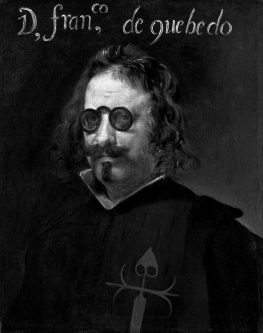
He himself often satirized his own physical flaws: he was nearsighted, limped, was short and unattractive. He also acknowledged traits such as emotional detachment, intellectualism, calculation, and misogyny. Books were his friends, while his enemies were countless.
Francisco de Quevedo served as adviser to the Duke of Osuna in Sicily. However, various dark incidents in Italy led to his imprisonment. With the rise of Philip IV, he was appointed royal secretary, while his political opponents faded into imprisonment.
He continued writing extensively, criticizing everyone, and even faced the Spanish Inquisition. He entered into a marriage of convenience in 1634, which lasted only briefly.
In 1639 he was imprisoned again for political reasons and was released a year before his death, already ill and aged.