Song, as an auditory creation, preceded the lyrics. When song became text, it was recorded—that is, fixed like an image—and ceased to be shaped, enriched, adjusted, and completed in performance… Unfortunately…
Thus, the folk song grew and spread. One person would begin it, another would take it up, and from place to place it would change sonically in its metre, its language, and its rhythm.
T. K. Blougouras (born 1930) studied at the primary school of Minagia in Pylia and at the Gymnasium of Pylos in Messenia before completing his studies in Philology at the University of Athens.
He worked in public education as a teacher, principal, and headmaster of secondary schools. He grew up in his birthplace, Minagia in Pylia, where he attended primary school.
He heard them, loved them, and told them in moments of youthful joy. The present work is the fruit of that love—better described as the result of long familiarity and deep engagement, enriched by lyrical retrospections.
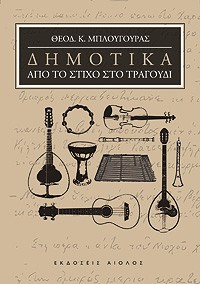
Carefully curated, 353 folk songs are now set out on display. Not silent “texts,” but lively and expressive, filled with their own voices and words.
A product of long collective creation, it has forgotten its originator—the one who laid the first stone, the first word, the first verse. No one cared to record his name, because the work belonged to everyone, that is, to the people—the demos, hence “demotic” (folk).
The author introduces us to 353 folk songs, examples of an art that has now passed, a once-vibrant culture expressing the sorrows, desires, and yearnings of the people of this land. He analyses them, classifies them, and presents them adorned with all the richness of their artistry. A grand and well-documented work, the result of years of study and devotion.