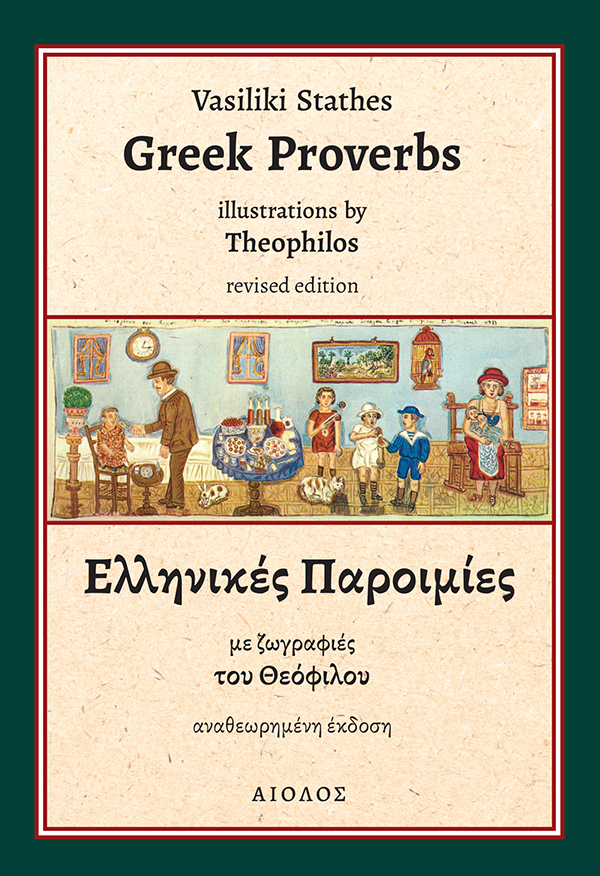
The proverbs of our people embody folk wisdom about human nature and possess a timelessness that continues to astonish.
The proverbs collected through the author’s research are presented in both Greek and English.
The book is illustrated with works by the folk painter Theophilos.
Vasiliki J. Stathes (also known as Billie Wills, 17 May 1917 – 13 November 2016) was born in Washington, D.C., the daughter of Greek immigrants. Her parents made a significant contribution to the local Greek community. After completing her studies, she worked for the United Nations and its predecessor, the League of Nations.
After settling in the state of Florida, Vasiliki J. Stathes worked for forty years as a teacher of foreign languages and fine arts at Miami Senior High School, combining her passion for languages, the arts, teaching, and intercultural communication. She was beloved both by her students and by the local community, and became known for her innovative teaching methods.
Throughout her life, Billie collected Greek proverbs and ancient Greek maxims, a reflection of her love for words as well as for the folk wisdom of her ancestral homeland, Greece.
Proverbs in every culture carry the accumulated wisdom of the people regarding human nature. They are passed down from generation to generation with a remarkable sense of timelessness, as their spirit—often witty and satirical—still resonates with our lives today. They hold such truth that we use them effortlessly in everyday speech, rarely stopping to consider that their origins lie in the wisdom of our ancestors.
“…I began my research into this remarkable world of folk wisdom among friends, relatives, and members of our diaspora community, collecting more than five hundred witty and insightful proverbs. My subsequent journey to Greece allowed me, after countless searches through books that record this rich heritage and conversations with people in towns and villages where these sayings are still in use, to select the most well-known and widely used expressions. Many of them have roots in antiquity, and it is truly remarkable that Greeks still use them in their daily lives today…”
From the foreword of the edition